

You can spot a mistake in your federal tax return anytime after filing. Maybe you missed a W-2, chose the wrong filing status, or forgot to claim a refund you were entitled to.
This is very common for Indians in USA because they have to manage foreign income and multiple reporting requirements.
What matters now is how well you correct it. The IRS provides you an official way to fix errors in a filed return through Form 1040-X.
There are records where filers made mistakes while filing amended returns too. This is why working through it with a tax expert always ensures the correction is filed accurately and completely.

Do You Actually Need to Amend Your Return?
Not every error on a filed return requires you to submit Form 1040-X. Before you proceed, it is worth confirming that your situation actually calls for an amendment.
Situations That Require Amendment
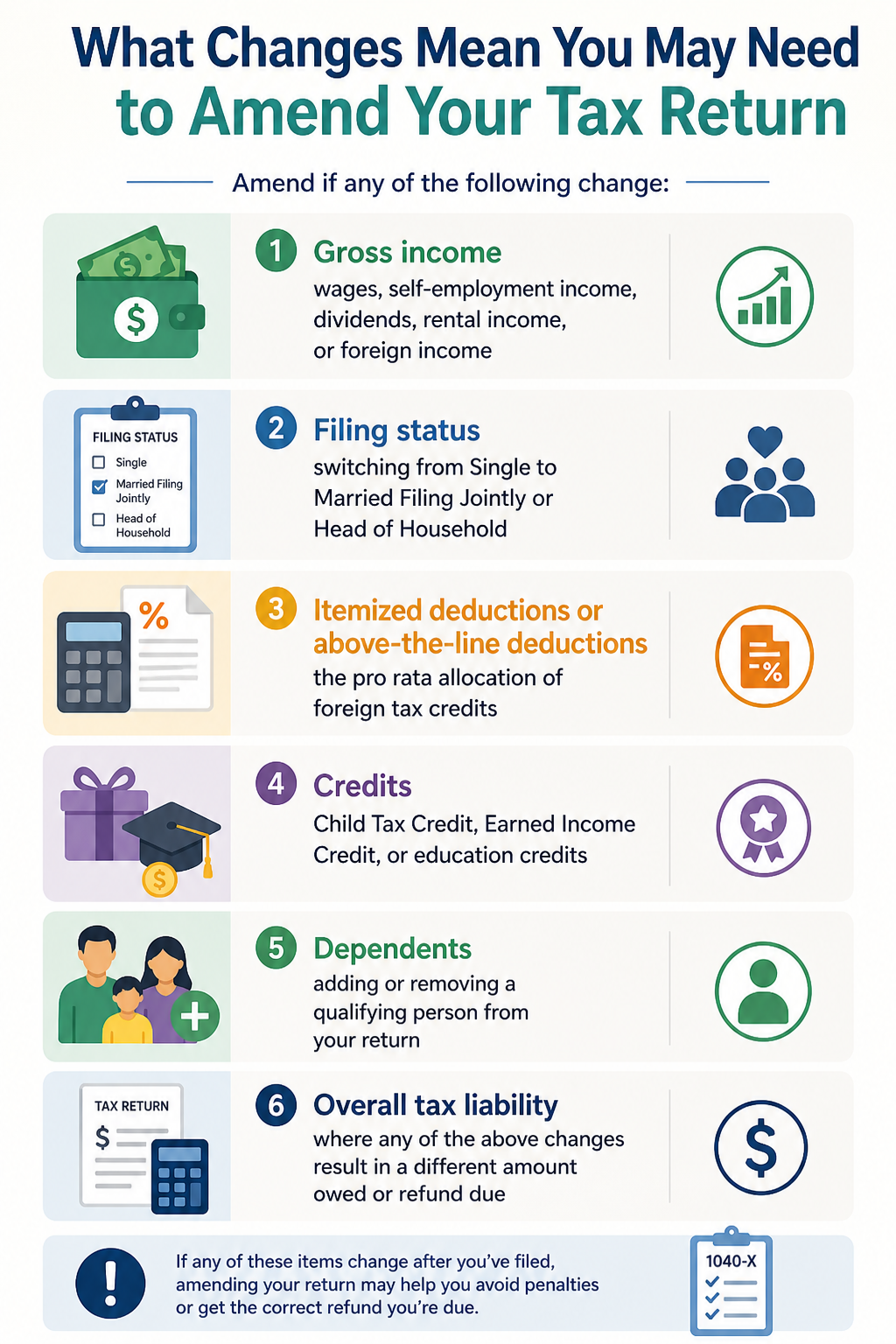
Situations Where Amendment Is Not Required
The IRS can intervene and correct certain errors on your part, for which you don’t always require 1040-X.
| Scenario | Reason |
| Math errors on your return | The IRS corrects the calculation automatically and notifies you by mail. |
| Missing W-2 or 1099 form | The IRS requests the document directly from the issuer and contacts you. |
| Forgot to attach a schedule | The IRS will contact you to request the missing schedule. |
| Received an IRS notice with adjustments | Follow the instructions in the notice. Do not file a 1040-X unless the notice specifically directs you to do so. |
| IRS rejected your e-filed return | Correct the rejection reason and resubmit the original return. This is not an amendment. |
| Received an audit notice | Follow the audit instructions provided by the IRS. Filing a 1040-X in response to an audit notice is not appropriate. |
| ⚠️ Note
If you receive an IRS notice, read it carefully before taking any action. Many notices are informational or request specific documentation, not an invitation to amend. Filing a 1040-X when it is not required can complicate your account and delay resolution. |
How Long Do You Have to File an Amended Return?
There is a statute of limitations on amendments. The IRS will not accept a 1040-X filed outside the applicable window.
The Standard Rule
You must file Form 1040-X within the later of –
- 3 years from the date you filed your original return, or
- 2 years from the date you paid the tax for that year
| 📅 Note for Early Filers
If you filed your return before the April deadline, the IRS counts the 3-year window from the April due date. This means early filers get the same three-year window as those who filed on the deadline. |
There are limited exceptions to this standard rule. These include situations involving net operating losses carried back to prior years, certain foreign tax credit claims under IRC Section 905(c), and cases involving a financially disabled taxpayer. These exceptions are narrow and fact-specific.
| 💡 Crescent Tip
Before preparing your amended return, confirm that your correction falls within the applicable 3-year window. If you are close to the deadline, prioritize filing over perfecting. A timely filed 1040-X that needs minor corrections is far better than a late one that is rejected entirely. |
If your situation involves international income, foreign financial accounts, or any discrepancy that spans multiple tax years, it is worth consulting tax filing services before the IRS identifies the issue on its own.
How To Amend Your Tax Return Using Form 1040-X?
Form 1040-X is the only IRS-approved mechanism to correct a previously filed federal individual income tax return. The IRS won’t initiate this on your behalf, you must file it yourself.
You can access Form 1040-X in two ways:
- Through the tax software platform you used to file your original return (strongly recommended)
- By downloading the form directly from the IRS website (irs.gov)
Step 1
Wait until your original return is fully processed.
Do not file your 1040-X until the IRS has fully processed your original return.
If you are expecting a refund from the original return, wait until you have received it.
Filing an amendment before the original is processed can delay both returns and create reconciliation issues in your IRS account.
Step 2
Choose Your Filing Method!
This determines your starting point and affects how much manual work you will need to do.
Option A: Through Tax Software
Log into the same platform you used for the original return and select the option to amend. The software will create a copy of your original return and auto-populate Column A of Form 1040-X. This significantly reduces the risk of transcription errors.
Option B: Manual or Paper Filing
Download Form 1040-X from the IRS website. You will need to manually refer to your original return and enter the original figures into Column A yourself. This approach requires careful attention to accuracy.
Step 3
Gather All Required Documents Before You Begin!
Starting the form before you have everything in hand is the most common source of errors and delays.
What will you need?
- A copy of your originally filed return – Form 1040, 1040-NR, or the applicable variant along with all attached schedules
- Any new or corrected income documents, such as a W-2c or corrected 1099
- Documentation supporting any deductions or credits you are now claiming or adjusting
- Indian expats in the US with international tax positions may need foreign income records, proof of foreign taxes paid, FBAR filing confirmations, and any FATCA-related documentation
| 💡 Crescent Tip
If you are amending a return that involves foreign income, foreign tax credits, or a Form 2555 (Foreign Earned Income Exclusion), the interaction between your correction and the original calculations can be complex. An error in one area often has pro-rata effects on others. It is worth reviewing the full return, not just the line you think needs changing before you file. |
Step 4
Recalculate Your Correct Tax Figures!
Form 1040-X does not calculate your taxes from scratch. You must calculate the corrected numbers independently before filling in the form.
Check what was originally reported, what the correct figures should be, and how you discovered that “change” as your total tax liability.
Step 5
Complete Form 1040-X!
Form 1040-X is structured around three columns. This is the core of the amendment.
What Are Columns A, B, and C?
| Line | Column A (Original) | Column B (Net Change) | Column C (Corrected) |
| 1 | $50,000 | + $5,000 | $55,000 |
| Example | Wages reported originally | Missed 1099 income added | Total corrected gross income |
- Column A reflects what you originally reported.
- Column B shows the net change, positive if you are adding income or reducing a deduction, negative if the reverse.
- Column C shows the final corrected figure.
Only adjust the lines that are actually affected by your correction. Do not re-enter or revisit unrelated line items.
Filing Status
Enter your filing status at the top of the form. If you are amending a joint return, both spouses must sign the completed 1040-X.
Part III – Explanation of Changes (Required)
This section is mandatory and often underfilled.
You must clearly state:
- What changed on the return
- Why the original figure was incorrect
- What supporting documentation substantiates the correction
| ✏️ Example
“Amending to include Form 1099-MISC income of $5,000 received from [Payer Name] after the original return was filed. The corrected gross income is $55,000. Updated Schedule C is attached.” Be specific. Vague explanations slow processing and may trigger follow-up requests from the IRS. |
Step 6
Attach Only Relevant Supporting Documents!
Include new or corrected income forms (W-2c, corrected 1099), updated schedules affected by your change, and any forms being added that were not on the original return.
Do not attach your entire original return or any documents not related to that specific correction.
Step 7
Submit Your Amended Return!
File a separate Form 1040-X for each tax year you are amending.
The IRS accepts up to three amended returns per tax year.
| Filing Method | Availability and Notes |
| E-file | Available for the current tax year and up to two prior years. Faster processing. Recommended where eligible. |
| Paper filing | Required for older years or certain special cases. Mail to the address listed in the Form 1040-X instructions for your state of residence. |
Step 8
Pay Any Additional Tax Without Delay!
If your amendment results in an increased tax liability, pay the additional amount as soon as possible.
Interest on underpaid tax is calculated from the original due date of the return, not from the date you file the amendment.
Payment can be made online via IRS Direct Pay or by check mailed with the appropriate payment voucher.
Step 9
Track Your Amended Return!
After submission, wait approximately three weeks before checking the status.
Use the IRS’ tool ‘Where’s My Amended Return?‘
Processing stages: Received → Adjusted → Completed.
| ⏳ Processing Time
The IRS typically takes 8–12 weeks to process an amended return. During high-volume periods or when additional review is required, processing can extend to 16 weeks or more. Avoid calling the IRS to check status until at least three weeks have passed and you have verified the return shows as received in the tracking tool. |
What Happens After You Submit Form 1040-X?
Once the IRS processes your amended return, there are three possible outcomes.
- If your amendment results in a refund:
The IRS will issue it, typically by paper check for paper-filed amendments. E-filed amendments for recent years may be eligible for direct deposit.
- If your amendment results in additional tax due:
The IRS will apply the payment you made and confirm the updated balance. If you did not pay in full, interest will continue to accrue on the outstanding amount.
- If the IRS makes further adjustments:
You will receive a notice explaining any additional changes the IRS made to your account as a result of the amendment. Review the notice carefully before responding.
If your refund claim is approved for a year within the statute of limitations, the IRS will also apply any applicable interest on the refund amount, calculated from the date you overpaid.
What Are the Most Common Mistakes People Make When Amending?
The 1040-X process is straightforward in structure but easy to get wrong in execution. These are the errors that most frequently delay processing or result in follow-up correspondence:
- Filing the amendment before the original return is processed — this creates a reconciliation problem in the IRS system
- Using Column C figures in Column A — a common data-entry error when filling the form manually
- Writing a vague or incomplete explanation in Part III — statements like ‘correcting income’ are insufficient; the IRS needs to know what income, from where, and why it was missed
- Fixing one line without accounting for downstream effects — for example, correcting income without adjusting self-employment tax, or changing a deduction without recalculating the alternative minimum tax (AMT) exposure
- Forgetting to update state returns — if your federal correction changes your federal adjusted gross income (AGI), your state return almost certainly needs a corresponding amendment as well
- Attaching the entire original return instead of only the changed schedules — this does not cause rejection but adds bulk and can slow processing
- Missing the statute of limitations — filing a refund claim outside the three-year window means the IRS will disallow it regardless of merit
| Avoid Making a Second Mistake While Fixing the Original One!
Get your return reviewed by experts who handle amendments, foreign income, and compliance issues every day. |
FAQs
1. How to amend a tax return 1040-X?
Use Form 1040-X to report changes. Recalculate correct figures, fill original vs change vs corrected amounts, explain the reason, attach supporting documents, and submit via e-file or mail after your original return is processed.
2. Do I need to send corrected 1040 with 1040-X?
A fully corrected Form 1040 (or 1040-NR) is generally submitted along with Form 1040-X, especially for paper filing, along with any updated schedules and supporting forms relevant to the changes.
3. Where to send an amended 1040-X?
Mail Form 1040-X to the IRS address listed in the form instructions, which varies by location and whether a payment is included. E-filing is available for recent tax years through approved software.
4. When can a taxpayer electronically file Form 1040-X to amend a return?
Electronic filing for Form 1040-X is available for the current tax year and up to two prior years, provided the original return has already been processed by the IRS.
Conclusion
For a simple correction like a missed 1099 or a small deduction error, filing Form 1040-X is manageable.
But when your return involves foreign income reporting, multi-year missed filings, or an existing IRS notice, it becomes a compliance issue.
In these cases, fixing one error without understanding the does and don’ts can create bigger problems.
This is a sign you need experienced guidance by your side.
At Crescent, we deal with this often after the tax deadline passes. Someone files, spots an issue, and isn’t sure how far it goes.
With more than 27,000 Indians in USA assisted, including professionals and business owners, our team of tax preparers focuses on getting these corrections right with every matter disclosed.
Backed by 85+ experienced enrolled agents, IRS-authorized e-filing, and a 95%+ satisfaction rate, the goal is complete and accurate compliance.
If your case feels even slightly complex, it’s worth having it reviewed by a tax expert before you amend.
Disclaimer: This content is for general informational purposes only and should not be considered tax, legal, or financial advice. Please consult a qualified professional for advice specific to your situation.