Last year, 5.5 million new business applications were filed in the United States, the highest number on record. If you’re one of those founders who just formed an LLC, congratulations. You’ve taken the first step toward building something meaningful.
Now comes the part nobody warned you about. LLC taxes.
Here’s what typically happens. You file your articles of organization, get that official confirmation email, and feel like a real business owner. Then tax season rolls around, and you realize you have absolutely no idea what filing business taxes for an LLC for the first time actually means. Do you file a corporate return? A personal return? Both? Neither?
The confusion is real, and you’re not alone. LLCs represent 85% of all business formations these days, yet most founders stumble through their first tax season like they’re navigating in the dark. Getting professional tax services can save you from expensive mistakes and sleepless nights during tax season.
Let me walk you through everything you need to know about LLC taxes in plain English, without the bureaucratic jargon that makes your eyes glaze over.
The Big Surprise: Your LLC Taxes Don’t Actually Pay Taxes
This is the part that confuses everyone, so let’s start here.
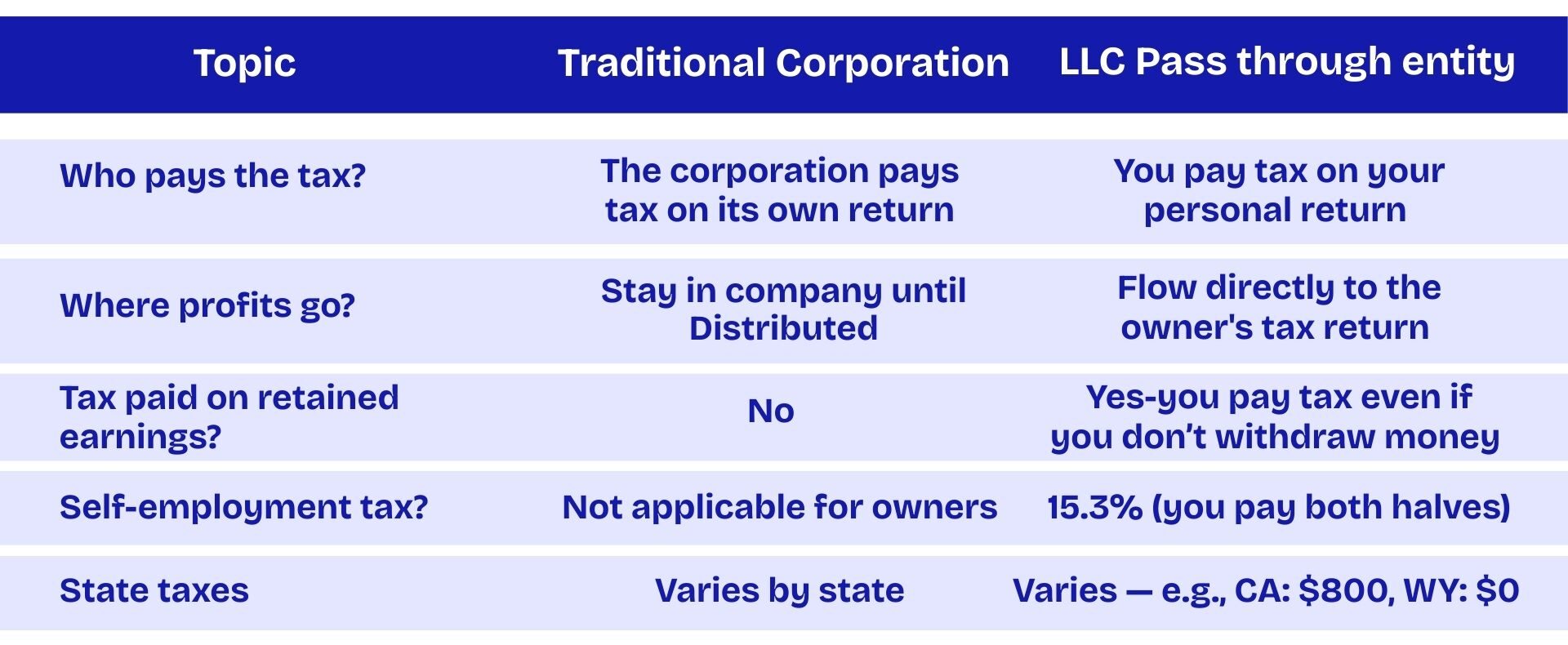
Your LLC isn’t like a traditional corporation. It doesn’t file its own tax return and pay taxes at the business level. Instead, it’s what the IRS calls a “pass-through” entity, think of it like a transparent pipe where the IRS sees right through your business structure to you personally.
All the profits and losses from your LLC flow directly onto your personal tax return. And here’s the kicker that catches most new founders off guard: you pay taxes on LLC profits even if you leave every dollar sitting in your business bank account. Made $50,000 profit but didn’t take a single distribution? You still owe taxes on that $50,000.
Beyond regular income tax based on your bracket, you’ll also face self-employment tax a 15.3% levy covering Social Security and Medicare. When you were an employee, your employer paid half of this. As an LLC owner, you pay both halves. Then add state taxes, which vary wildly depending on where you operate. California charges an $800 annual franchise tax while Wyoming charges zero.
How Your LLC Taxes Get Taxed, Understanding Your Options
The beauty and complexity of LLC taxes is that you have choices. Here’s how it breaks down.
Single-Member LLC Taxes (The Default Route)
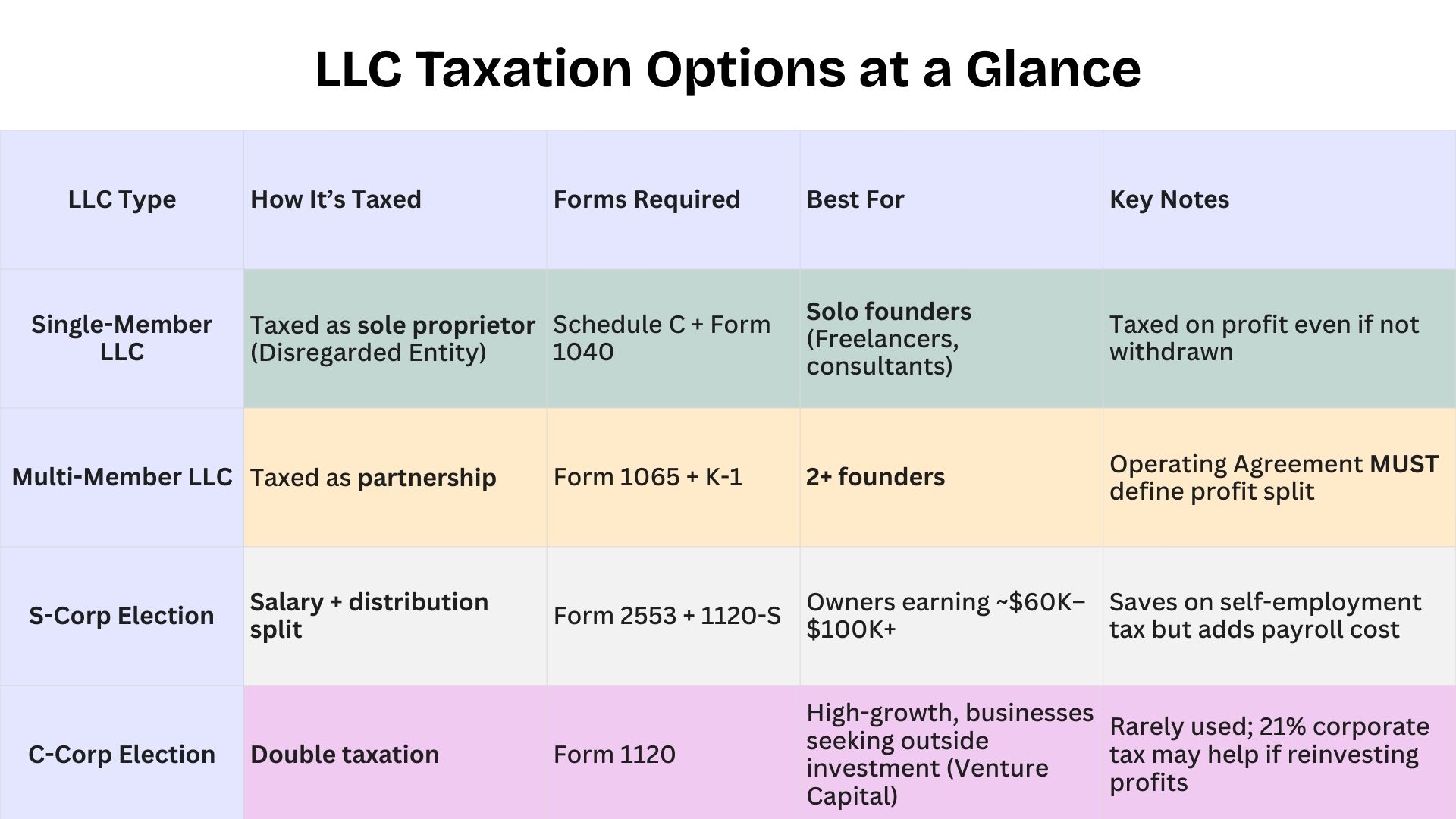
If you’re the only owner, your LLC is considered a disregarded entity for tax purposes. You file Schedule C with your personal Form 1040, reporting your business income and expenses just like a sole proprietor.
Take Sarah’s graphic design LLC as an example. She earned $60,000 last year and spent $8,000 on software and equipment. Her taxable income: $52,000. She paid $7,956 in self-employment tax plus roughly $6,000 in federal income tax, for a total tax burden of $13,956. Simple to file, but that self-employment tax hurts.
The biggest misconception? “I don’t need to report income until I withdraw it from the business.” Wrong. You’re taxed on net profit whether you touch that money or not.
Multi-Member LLC Taxes (Partnership by Default)
With two or more owners, your LLC files Form 1065 as a partnership. Each member gets a Schedule K-1 showing their share of income or loss. Here’s a critical detail most founders miss: your profit split must be defined in your Operating Agreement. Don’t have one? That’s a problem waiting to happen.
Even if your LLC had zero profit, you still need to file Form 1065. Failing to file invites IRS penalties, even when you don’t owe any tax.
LLC Taxes Electing S-Corp Status (The Tax-Saver)
This is where things get interesting. Once your LLC reaches consistent profitability, typically $60,000 to $100,000 in net profit, you might benefit from electing S-Corp taxation using Form 2553.
Consider Rahul and Priya’s IT consulting LLC. They made $200,000 net profit, split 50/50. With the S-Corp election, each took a $70,000 salary plus $30,000 distribution. They paid $21,420 total in self-employment tax. Without the election? They’d have paid $30,600. That’s $9,180 in savings.
Try to understand it in this way. Running an S-Corp payroll costs money (about $3,000 annually), plus accounting fees jumped to $1,500. Net benefit: $4,680. Not life-changing, but nothing to sneeze at either.
The controversial question every founder asks. At what income level does an S-Corp make sense? Tax professionals debate this constantly. Some say $60,000, others insist on waiting until $100,000. The answer depends on your specific situation, industry, and how much complexity you can handle.
LLC Taxes Electing C-Corp Status (The Rare Exception)
Most LLCs shouldn’t elect C-Corp taxation because of double taxation. The corporation pays tax on profits, and then you pay tax again on dividends. However, if you’re building a capital-intensive business that reinvests every dollar, C-Corp status might work.
The Patel family’s real estate LLC elected C-Corp taxation to hold rental properties and reinvest all profits. They pay 21% corporate tax, retaining 79% for property acquisition instead of 65-70% if income is passed through to their high personal tax brackets. It works for their growth strategy, but it’s definitely the exception, not the rule.
LLC Taxes and The Self-Employment Tax Reality Check
Let’s talk about the tax that shocks every new LLC owner. It is a self-employment tax.
This 15.3% consists of 12.4% for Social Security (up to $168,600 in 2024) and 2.9% for Medicare (no income limit). High earners pay an additional 0.9% Medicare tax on income exceeding $200,000.
When you were an employee, your paycheck stub showed your employer paying half (7.65%) of these taxes. As an LLC owner, you pay the full 15.3% and it’s on top of your regular income tax.
Here’s a practical example. You make $80,000 net profit from your LLC. Your self-employment tax bill: $12,240. Then add your income tax based on your bracket, let’s say 22% for another $17,600. Total: $29,840 in taxes, or 37.3% of your profit.
The silver lining? You can deduct half your self-employment tax when calculating your adjusted gross income. And if you elect S-Corp status, you can reduce this burden significantly by splitting income between salary and distributions.
Quarterly Estimated LLC Taxes: The Payment Schedule You Can’t Ignore
Here’s where many founders get hit with penalties in their first year.
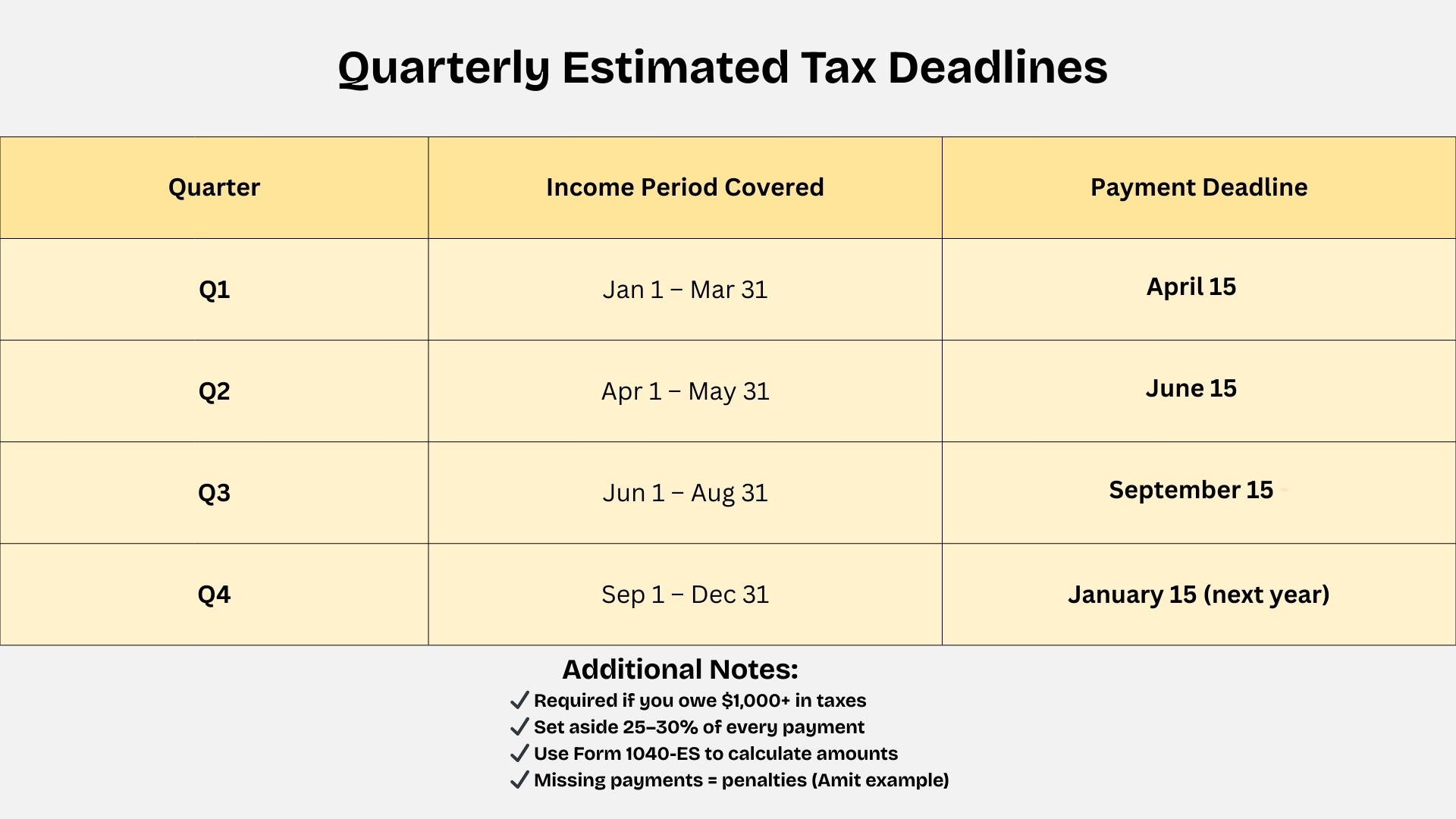
The IRS doesn’t want to wait until April 15 to collect your taxes. They expect quarterly estimated tax payments on April 15, June 15, September 15, and January 15. If you’ll owe $1,000 or more when you file, quarterly payments aren’t optional; they’re mandatory.
Amit learned this the hard way. He ran an e-commerce LLC, earned $75,000 through Q1-Q3, but paid zero in estimated taxes. When he filed in April, he owed $11,475 plus a $287 underpayment penalty. Not massive, but completely avoidable.
Use Form 1040-ES to calculate what you owe. A simple rule: set aside 25-30% of every payment you receive. Open a separate savings account labeled “Tax Fund” and transfer money immediately when clients pay you. When quarterly deadlines arrive, the money’s already there.
The safe harbor rules protect you from penalties: pay 100% of last year’s tax (110% if you’re a high earner) or 90% of this year’s tax. Even if you underestimate, you’re covered as long as you hit these thresholds.
State Strategy LLC Taxes: Where You Form Actually Matters
Wyoming saw 42% growth in LLC formations last year, and there’s a reason: no state income tax and minimal annual fees.
Compare two scenarios. A California LLC earning $100,000 pays $15,000 federal tax, $15,300 self-employment tax, $800 franchise tax, and roughly $6,000 state income tax, totaling $37,000. The same LLC was formed in Texas? $30,300 total, saving $6,700 annually with no state income tax or franchise tax.
But here’s the trap: you can’t just form in Wyoming while operating in California and expect to avoid California taxes. States are cracking down on this arbitrage. New York recently audited a Wyoming LLC with a single remote employee living in New York, claiming the entire LLC income was taxable in New York. The founder faced $15,000 in back taxes plus penalties.
The general rule: the form where you actually operate. If you’re running a coffee shop in Los Angeles, form in California. Multi-state operations or purely online businesses might legitimately benefit from Delaware or Wyoming, but get professional advice before trying to outsmart state tax authorities.
Common LLC Taxes Mistakes That Cost Founders Thousands
Let me save you from these expensive errors I see repeatedly.
Mistake 1: No separate business bank account. Mixing personal and business finances creates bookkeeping nightmares, raises audit red flags, and can “pierce the veil,” destroying your liability protection. Open a business checking account this week.
Mistake 2: Missing the S-Corp election deadline. March 15 is the deadline to elect S-Corp status for the current year. Miss it, and you lose a full year of potential tax savings. Mark your calendar in December to decide by January.
Mistake 3: Claiming every possible expense. The IRS reports that 15% of self-employed individuals incorrectly classify business expenses. Getting aggressive with deductions triggers audits. When uncertain, ask a professional rather than guessing.
Mistake 4: Not keeping documentation. Can’t prove an expense? Can’t deduct it. The IRS requires 7-year record retention. One founder lost $8,000 in legitimate deductions during an audit because he couldn’t produce receipts. Digital photos stored in the cloud solve this completely.
Your First-Year Action Plan
Here’s what to do right now:
Foundation Setup (Month 1):
- Get your EIN from the IRS (takes 5 minutes online, completely free)
- Open a business bank account
- Set up accounting software (QuickBooks, FreshBooks, or Wave)
- Create a separate tax savings account
Throughout the Year:
- Set aside 25-30% of every payment for taxes
- Track ALL expenses with receipts or photos
- Keep personal and business finances 100% separate
- Mark quarterly tax deadlines on the calendar
Before Year-End:
- Project total annual income
- Calculate Q4 estimated tax
- Evaluate S-Corp election for next year
- Buy needed equipment before December 31 to maximize deductions
Tax Season:
- Gather all 1099s and income records
- Compile expense documentation
- File by the April 15 deadline
- Review what worked for next year
When to Get Professional Help with LLC Taxes
DIY works fine initially, but recognize when you need expertise. Consider help from a professional tax expert when annual revenue exceeds $100,000, you’re considering an S-Corp or C-Corp election, you operate in multiple states, you have foreign ownership, or you’re facing IRS notices.
Basic LLC tax preparation runs $500-$1,500. S-Corp returns cost $1,500-$3,000. Add $500-$1,000 per state for multi-state filing. Remember: these fees are deductible business expenses.
Look for an Enrolled Agent or CPA specializing in small business. Ask about their experience with your industry and expect proactive advice, not just compliance work. The cost of mistakes usually exceeds the cost of professional guidance.
FAQs About LLC Taxes:
How to File Taxes for LLC?
To file taxes for your LLC in the USA, you’ll need to determine your LLC’s tax classification (single-member, multi-member, S-Corp, or C-Corp). Single-member LLCs report income on Schedule C with their Form 1040, while multi-member LLCs file Form 1065 and issue Schedule K-1 to each partner. These LLC tax forms help determine how much tax you owe based on your LLC’s structure and income. If you’ve elected S-Corp status, file Form 1120-S. Don’t forget to pay self-employment taxes if applicable. Seek tax accountant help for the first time filings.
How to Get Tax ID for LLC?
To get a Tax ID (EIN) for your LLC, apply online through the IRS website. It’s free and takes just a few minutes. You’ll need your LLC formation details, including the legal name and the responsible party’s information. An EIN is essential for opening a business bank account, hiring employees, and filing taxes.
How to File Business Taxes for LLC?
Filing business taxes for your LLC depends on its structure:
- Single-member LLC: File income and expenses on Schedule C with your Form 1040.
- Multi-member LLC: File Form 1065 and distribute Schedule K-1 to members.
- If you’ve elected S-Corp or C-Corp status, file the respective forms (Form 1120-S for S-Corp, Form 1120 for C-Corp). Don’t forget to include quarterly estimated tax payments.
How to File LLC Taxes?
To file LLC taxes, you’ll need to report your business income and expenses on the correct forms:
- Single-member LLC: Use Schedule C with Form 1040.
- Multi-member LLC: Use Form 1065, and each member reports their share on Schedule K-1.
If your LLC is taxed as an S-Corp, file Form 1120-S. Make sure to make quarterly estimated tax payments if necessary.
How to File Taxes as LLC?
To file taxes as an LLC, you must first know your LLC’s tax structure:
- Single-member LLC: Report income on Schedule C with Form 1040.
- Multi-member LLC: File Form 1065 and issue Schedule K-1 to each member.
F or S-Corp or C-Corp elections, file Form 1120-S or Form 1120, respectively. Make sure you pay self-employment taxes and file quarterly estimated taxes if needed.
How do I file LLC taxes for the first time?
Single-member LLCs file Schedule C with Form 1040. Multi-member LLCs file Form 1065, with each member receiving a K-1. Both include business income, expenses, and deductions. Use the service of a tax expert for your first filing to establish good habits.
What’s the difference between LLC taxes filing and regular taxes?
LLC owners pay both income tax and self-employment tax (15.3%) on business profits. Regular employees only see income tax, with their employer handling the other half of Social Security and Medicare. LLCs also make quarterly estimated payments instead of automatic withholding.
Which LLC taxes form do I need?
Single-member: Schedule C (sole proprietorship). Multi-member: Form 1065 (partnership). S-Corp election: Form 1120-S. C-Corp election: Form 1120. Your member count and elections determine which forms apply.
Do I need quarterly payments for my LLC taxes?
Yes, if you expect to owe $1,000 or more when you file. Calculate using Form 1040-ES and pay by April 15, June 15, September 15, and January 15. Missing payments triggers penalties even if you’re getting a refund.
Can I change how my LLC is taxed?
Yes. File Form 8832 to elect corporate taxation or Form 2553 for S-Corp status. Single-member LLCs default to sole proprietorship taxation, and multi-member LLCs default to partnership taxation. Elections must meet specific deadlines and requirements.
The Bottom Line
Understanding LLC taxes isn’t about memorizing IRS codes; it’s about building systems that keep you compliant while maximizing what you keep. Effective LLC tax filing is essential for every business owner to stay on top of their obligations and avoid costly mistakes. You’ve joined 5.5 million other founders who filed in 2023. Most figured it out, and you will too.
Start simple with default taxation, track every expense meticulously, set aside money for quarterly payments, and recognize when complexity justifies hiring help. Your LLC is a tool for building wealth, not a tax headache waiting to happen. Seek help from a tax expert if you feel it’s perplexing.
Focus on what you do best, like serving customers and growing revenue. With proper systems in place, tax compliance becomes routine rather than stressful.