
Indians in USA should not wait until March because March creates a time crunch that increases missing documents, wrong withholding fixes, and foreign reporting errors, especially FBAR filing and FATCA reporting. The IRS states that April 15, 2026 is the deadline to file and pay for most calendar-year taxpayers.
March feels “one month early,” but it is often “too late to work calmly.” A clean return needs time for checking, not just typing.
IRS Deadline 2026: the date Indians in USA must plan around
The IRS lists April 15, 2026 as the filing and payment deadline for most individuals.
The IRS also notes the 2026 filing season opened and expects most people to file before the Wednesday, April 15, deadline.
That date is not the problem. The problem is what happens in the weeks before it.
Why March is risky for Indians in USA
March is when “normal delays” become “filing blockers.” The same patterns show up every year for Indians in USA:
1) Missing forms and corrected forms arrive at the worst time
Employers and banks can issue corrected statements. Brokerage tax forms can be revised. When filing starts late, there is no time to re-check and reconcile. That is how returns get filed with missing income, wrong numbers, or mismatches that trigger letters.
2) Foreign account details take time to gather
For Indians in USA, foreign financial life is often active:
- Indian savings accounts, NRE/NRO accounts
- Fixed deposits (FDs)
- Demat-linked holdings
- Indian mutual funds
- Joint family accounts
- Accounts where the signing authority exists
These details are not “extra.” They are central to FBAR filing and FATCA reporting.
A steady approach reduces risk. Always be informed about Late FBAR filings.
3) March encourages shortcuts
In March, people rush into:
- DIY filing with incomplete foreign details
- Sharing documents on insecure channels
- Copy-pasting numbers without verifying maximum balances
- Choosing a filing status without confirming residency rules
Shortcuts can create expensive fixes later.
4) Good support gets booked out
When March begins, quality review time becomes limited. A return that needs a careful tax expert review may end up being handled in a hurry.
This is why early booking matters for tax consultants and tax filing services.
FBAR filing: the March deadline panic that creates mistakes
FBAR filing is a common pain point for Indians in USA because it depends on facts that are not always in one place.
The IRS explains the FBAR is due April 15 following the calendar year reported and allows an automatic extension to October 15 if the April 15 date is missed—no extension request is needed.
That sounds flexible, but the real challenge is accuracy.
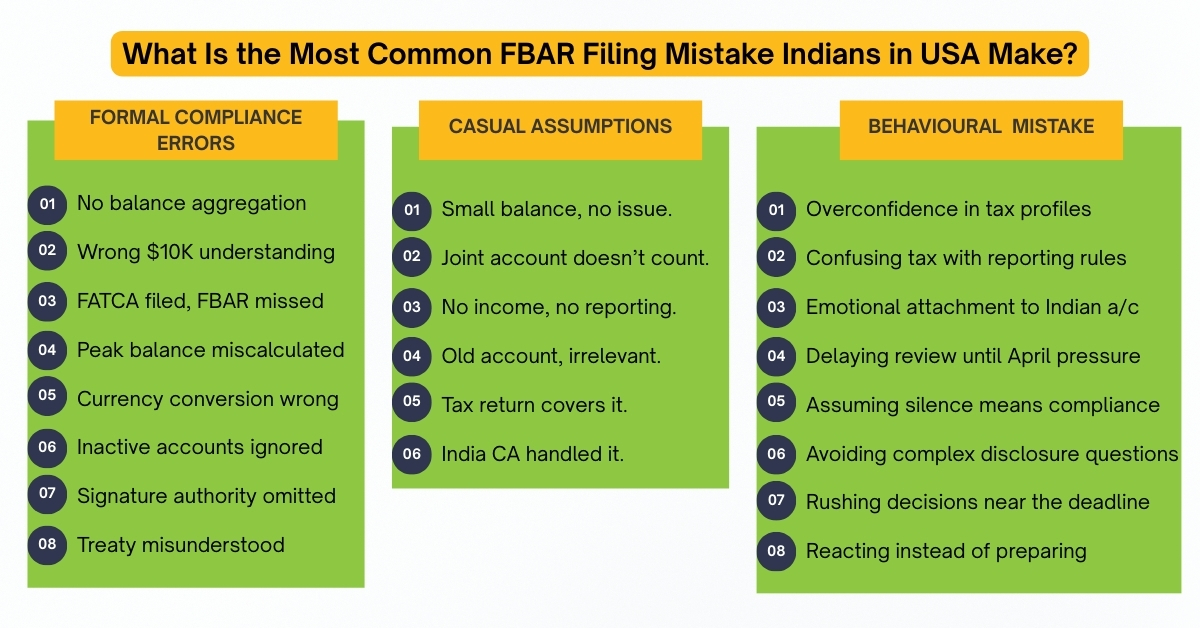
What goes wrong in the March FBAR filing
March errors usually come from missing information:
- Not having the maximum balance for each foreign account
- Forgetting an old bank account that is still open
- Misreporting a joint account
- Leaving out a signatory account (authority to sign)
Even when the intent is honest, the result can still be wrong.
Finding a clean service approach that covers both FBAR filing and FATCA reporting is a good idea.
FATCA reporting: why Form 8938 gets missed when filing starts in March
FATCA reporting often means Form 8938 for individuals.
The IRS states that Form 8938 is used to report specified foreign financial assets when the total value is more than the reporting threshold.
The IRS also provides a comparison of Form 8938 and FBAR requirements because taxpayers may need one, the other, or both.
Why March makes FATCA reporting worse for Indians in USA
March confusion usually looks like this:
- “FBAR is done, so FATCA reporting is done.” (Not always true.)
- “It is in the spouse’s name, so it does not count.” (Often wrong.)
- “It is an investment, not an account.” (Form 8938 can still apply.)
When filing begins earlier, a tax expert has time to ask the right questions and map assets to the correct reporting.
For a clear starting point on basic filing concepts for Indians in USA, see some of the best Beginner guide for a better understanding.
IRS Deadline 2026 and extensions: what March filers misunderstand
Many people assume an extension removes the pressure. It does not remove all pressure.
The IRS explains that an extension gives more time to file (often to October 15), but tax owed should still be paid by the April deadline to avoid penalties and interest.
So if March is used just to “get to an extension,” the real problem remains: the tax due still needs to be estimated and paid on time. That estimate is harder when documents and foreign details are still incomplete.
Always good to know what happens if you have missed the April deadline.
Resident vs nonresident: the quiet reason March filings break
For Indians in USA, tax residency status can change outcomes. Many assume their status is obvious and then discover it is not.
Residency impacts:
- What form is filed
- How worldwide income is treated
- What foreign reporting is triggered
- What treaty positions may be relevant
This is not a March decision. This should be confirmed early.
To be precise, learn about Resident vs Non-Resident. Also, be aware of the treaty basics available in any good Treaty guide.
Professional tax services: what “best tax filing service” should mean
People search “best tax filing service” when they want:
- fewer mistakes
- fewer IRS letters
- clear explanations
- secure handling of sensitive documents
For Indians in USA, the “best” service is usually the one with the best process.
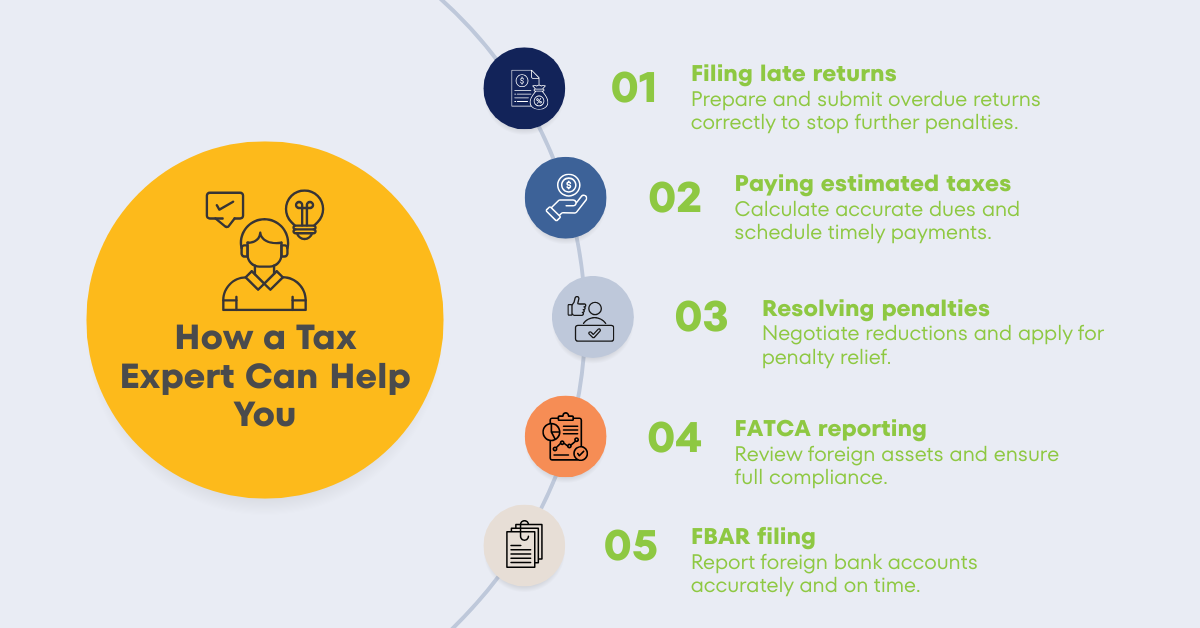
A reliable tax filing service process includes:
- a clear document checklist
- review of W-2/1099 consistency
- foreign account inventory for FBAR filing
- Foreign asset review for FATCA reporting
- a human review by a tax expert before submission
- guidance on what to keep as proof
Why Indians in USA should start in February, not March
Starting in February creates time for “boring checks” that prevent painful fixes.
February benefit 1: time to correct withholding issues
If withholding is low, March becomes stressful. February gives time to confirm amounts and plan payment.
February benefit 2: time to reconcile foreign details
Foreign reporting is detail-heavy. February gives time to gather bank letters, statements, and maximum balance proofs needed for FBAR filing and FATCA reporting.
February benefit 3: time to avoid “refund pressure”
Refund excitement can push people into weak preparers or risky claims. Early planning keeps decisions steady.
February benefit 4: better review time with tax consultants
Good tax consultants ask questions, review documents, and explain outcomes. That is harder to do well when everything starts in March.
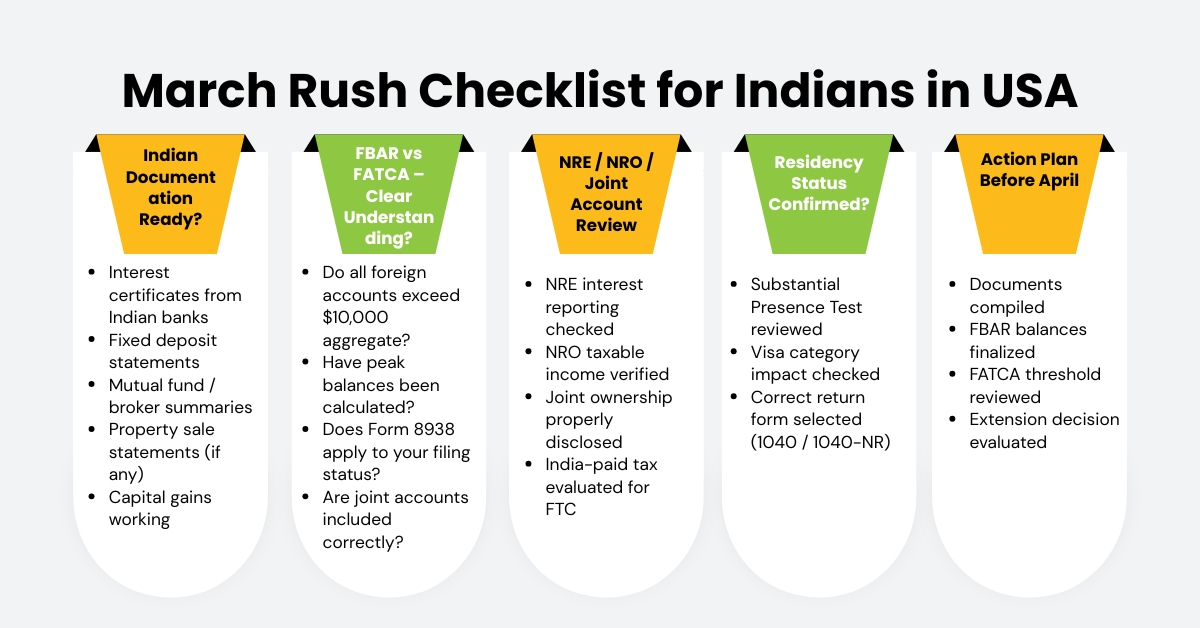
Simple checklist for Indians in USA: what should be ready before March
This checklist is designed for AEO-style “do this now” clarity.
A) Core U.S. tax documents
- W-2 (all employers)
- 1099 forms (bank, brokerage, gig platforms)
- mortgage interest (if applicable)
- tuition forms (if applicable)
- Last year’s tax return copy
B) FBAR filing list (foreign accounts)
Make one list of all foreign accounts and gather:
- bank name and address
- account number
- ownership type (single/joint/signatory)
- maximum balance during the year
The IRS FBAR page clearly states the April 15 due date and automatic extension to October 15.
C) FATCA reporting list (foreign assets)
List foreign assets that may be reportable and keep proofs of value ranges. The IRS Form 8938 page states the purpose: reporting specified foreign financial assets above the threshold.
The IRS comparison page helps avoid confusion between Form 8938 and FBAR.
D) Decide on support
When the profile includes foreign assets, status complexity, or multiple income streams, early review by professional tax services is usually safer than late DIY.
FAQs (People Also Ask style)
What is the IRS deadline 2026 for filing taxes?
For most individuals, the IRS lists April 15, 2026, as the deadline to file and pay.
Why should Indians in USA not wait until March?
Because March compresses time for document verification, increases foreign reporting mistakes, and pushes rushed decisions—especially for FBAR filing and FATCA reporting.
What is FBAR filing, and when is it due?
The IRS states the FBAR is due April 15 and has an automatic extension to October 15 if April 15 is missed.
What is FATCA reporting for individuals?
The IRS states Form 8938 is used to report specified foreign financial assets when the total value is more than the reporting threshold.
Are FBAR filing and FATCA reporting the same?
No. The IRS provides a comparison page that shows they are different requirements, filed differently, and can both apply.
Does an extension remove the need to pay by April 15?
No. The IRS explains that an extension gives more time to file, but payment is still due by the April deadline to avoid penalties and interest.
How to choose the best tax filing service for Indians in USA?
The best tax filing service is usually the one with a clear process: foreign reporting review, secure document handling, and a final review by a tax expert before filing.
Closing: the safest plan before IRS Deadline 2026
For Indians in USA, March should be a “review month,” not a “start month.” Early work reduces errors, improves completeness, and makes FBAR filing and FATCA reporting far easier to handle correctly. The IRS deadline is fixed, but the stress level is not.
Disclaimer: This blog is for general information only and is not tax, legal, or financial advice. Tax rules depend on individual facts and can change. For guidance on a specific situation, consult a qualified tax professional and rely on official IRS resources.