
March feels like there is still time.
That is why it causes trouble.
By March, most people have already delayed the hardest part of filing: checking what is missing. At that stage, the return often looks close to done, but the real risks are usually still sitting in the background. That is where late-season mistakes begin. For most calendar-year individual filers, the IRS filing date for tax year 2025 is April 15, 2026.
The danger is not always filing after the deadline.
The danger is filing before the review is complete.
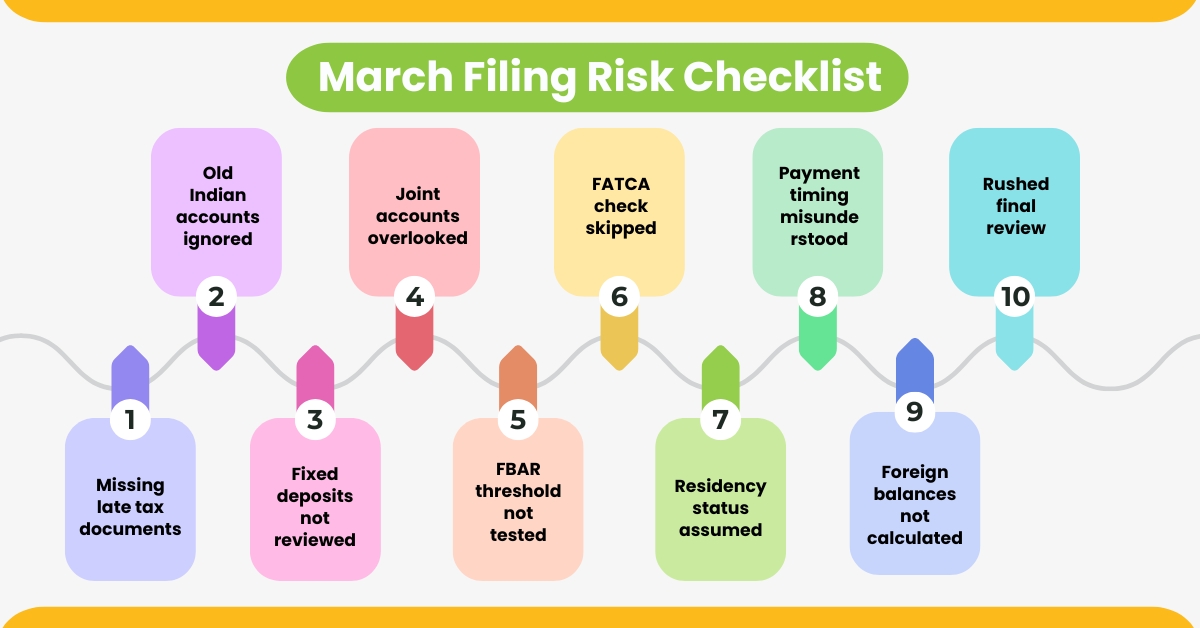
That usually means:
- Foreign accounts were not checked properly
- FBAR filing was never tested
- FATCA reporting was assumed away
- Payment timing was misunderstood
- One “small” account changed the whole filing picture
If the filing process still feels scattered, Individual Tax Filing is the cleanest place to start.
Why is March risky for tax filing services?
Because March changes how people make decisions.
In February, people ask:
- What do I still need to collect?
- Which accounts count?
- Do I need extra disclosure?
In March, the questions change:
- Can I finish this quickly?
- Can I skip this for now?
- Is this good enough?
That shift matters.
Once the goal becomes “finish fast,” the review gets weaker. The return may still be filed on time, but the filing quality drops. That is where avoidable follow-up work starts.
Good tax filing services do not improve returns by moving faster. They improve returns by forcing the work into the right order.
The season makes more sense when the timeline is clear. IRS Deadline 2026 helps frame that timing problem before it becomes urgent.
Why does FBAR filing become a March problem?
Because most people discover it late.
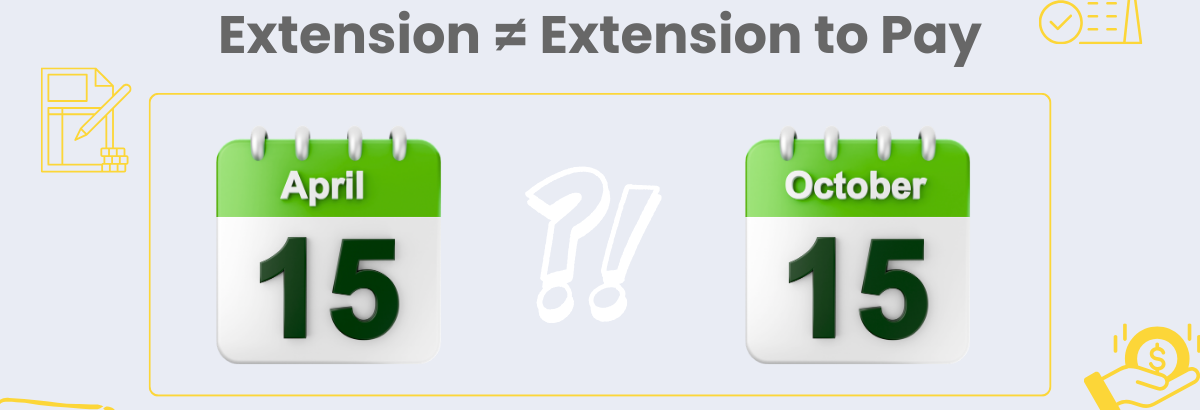
The IRS says FBAR filing may be required if the combined value of foreign financial accounts exceeds $10,000 at any point during the year. The IRS also says the FBAR due date is April 15, with an automatic extension to October 15.
The problem is not the rule.
The problem is the math behind the rule.
People often think account by account:
- one NRE account
- one NRO account
- one fixed deposit
- one savings account
- one joint account
None may look large by itself.
Together, they may cross the threshold.
That is why FBAR filing often becomes a late-March surprise. It does not usually come from one large balance. It comes from several ordinary balances added together.
This is especially common when someone has:
- an old account they no longer use often
- a fixed deposit, they forgot to include
- a joint family account, they do not mentally treat as theirs
- a brokerage account with little recent activity
These are not rare cases. They are normal cases.
That is why March is a weak time to start reviewing foreign accounts. The pressure to finish is high, and the review is usually shallow.
If prior-year exposure is part of the concern, Late FBAR Filing belongs in that review. If the current filing year includes foreign-account disclosure, FBAR Filing FATCA is the most relevant service page to use early, not after the return is already built.
For the seasonal filing cycle itself, FBAR Filing for Indians in USA helps place foreign reporting in the same calendar as the tax return.
Why is FATCA reporting easy to miss in March?
Because it hides behind a “mostly complete” return.
The IRS says Form 8938 is used to report specified foreign financial assets when the value exceeds the filing threshold that applies to the taxpayer. The IRS also says Form 8938 and FBAR are separate requirements, and one does not replace the other.
This is where a lot of March filers get caught.
They report:
- salary
- interest
- dividends
- capital gains
and think the return is done.
But FATCA reporting is not the same as reporting foreign income. It is a separate disclosure question. That means the return can look complete on the income side and still be incomplete on the asset side.
That becomes risky in March because this kind of review takes time. It usually requires:
- confirming ownership
- checking thresholds
- Listing foreign financial assets separately from income items
- deciding whether both reports are required
That is not good, last week’s work.
If the larger filing framework still needs to be clarified before disclosure details are checked, US Tax Filing is the right background page to keep open while the return is being built.
Why should a tax expert review residency before filing in March?
Because residency errors are expensive and easy to miss.
People often assume their tax position is obvious. It often is not.
Residency can change:
- what income is reportable
- how foreign assets are reviewed
- whether FATCA reporting thresholds matter
- whether a treaty issue should even be considered
The reason this matters in March is simple. By the time the return is nearly finished, most people do not want to revisit the foundation. They want to submit.
That is exactly when hidden mistakes stay hidden.
If the filing year included a move, visa change, longer U.S. stay, marriage, or change in filing position, the residency review matters even more.
Why do professional tax services matter more in March?
Because March compresses everything.
By then, a taxpayer may still need to:
- collect missing records
- confirm foreign account balances
- test FBAR filing
- test FATCA reporting
- review residency
- estimate payment due
- decide whether to file or extend
That is a lot to do at once.
This is why structured professional tax services matter more in March than people realize. They do not remove complexity. They stop complexity from becoming confusion.
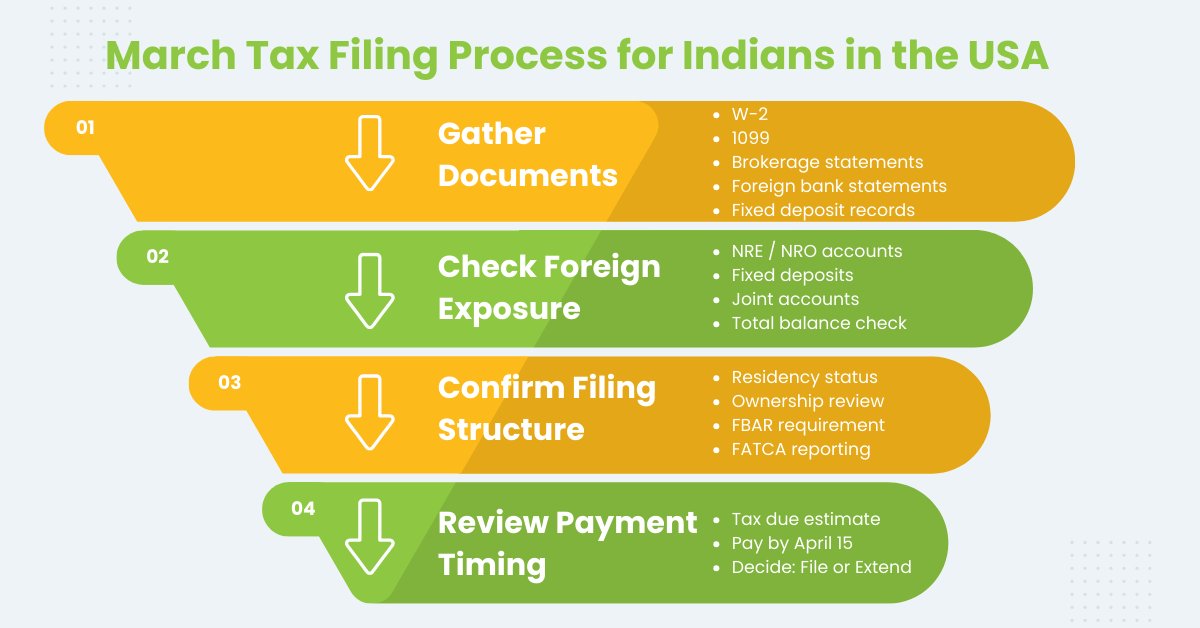
A strong process in March should look like this:
1. Gather first
Get:
- W-2s
- 1099s
- brokerage statements
- foreign bank statements
- fixed deposit records
- interest certificates
- records of major transfers
2. Check foreign exposure
Do not build the return until the foreign side is reviewed.
3. Confirm filing structure
Residency, ownership, and disclosure rules should be decided before submission.
4. Review payment timing
The IRS deadline is not only about filing. It is also about paying what is due. For most taxpayers, April 15 is the deadline to file and pay, and an extension gives more time to file, not more time to pay.
That sequence matters.
The later this starts, the more likely it is that one step gets skipped.
Why is the best tax filing service not always the fastest?
Because fast filing can hide a weak review.
That is the main point.
The best tax filing service is not the one that gets a return out the door first. It is the one that catches the problem before the return goes out.
That means reviewing:
- account totals
- account ownership
- foreign asset exposure
- FBAR filing
- FATCA reporting
- payment timing
- whether an extension is really needed
I have seen quick returns that later needed:
- amended returns
- separate foreign reporting fixes
- extra explanation because one issue was never checked properly
That is why March is risky. It invites speed at exactly the point where the return needs review.
A better way to look at the season is to build the filing in layers:
- facts
- thresholds
- disclosures
- payment
- filing
When those layers are rushed, mistakes become much easier to miss.
Why are payment mistakes common in March?
Because people think “file” and “pay” are the same task.
They are related, but they are not the same decision.
A taxpayer may:
- file an extension
- assume the deadline problem is handled
- delay payment
- later face interest or penalties
The IRS says an extension gives extra time to file, but not extra time to pay tax due.
That is one of the most common March mistakes because it feels small in the moment. The filer thinks, “I will sort the rest later.” But the payment issue is already active.
Why do tax consultants warn against “I’ll fix it later” thinking?
Because “later” is where cleanup lives.
This usually sounds like:
- “I will include that account next year.”
- “I will deal with the foreign side after filing.”
- “I will extend and think about it later.”
- “I will amend if needed.”
That thinking is dangerous because it treats corrections like a normal part of filing.
They are not.
Corrections take time.
Corrections add cost.
Corrections often start with a weak first review.
That is why seasoned tax consultants try to solve the real problem before the return is sent, not after.
FAQs
What is the filing deadline for tax year 2025?
For most individual filers, the IRS due date is April 15, 2026. The IRS also states this is generally the date to file and pay.
Is FBAR filing the same as FATCA reporting?
No. The IRS states that FBAR and Form 8938 are separate requirements. One does not replace the other.
Why is March risky for cross-border filers?
Because March compresses the review. That makes it easier to miss foreign accounts, thresholds, payment issues, and disclosure rules.
Can an extension solve the problem if filing starts late?
It can help with filing time, but the IRS states it does not extend the time to pay tax due.
Why should a tax expert check residency first?
Residency can affect what must be reported, including foreign income and whether some disclosure rules apply.
What makes the best tax filing service in March?
A process that checks the facts before submission. In March, review matters more than speed.
Final word
March is not automatically too late.
But March is when hidden filing problems become much easier to miss.
That is why the real risk is not the month itself.
It is the rush that comes with it.
If filing starts in March, the safest move is to slow the process down where it matters:
- review foreign accounts
- test FBAR filing
- test FATCA reporting
- confirm residency
- Check payment timing
That is what keeps a filing from becoming a correction project later.
A tax expert is not a last-minute fix.
A tax expert is what makes March feel like January.
Disclaimer: This article is for informational purposes only and does not constitute legal or professional tax advice. Tax rules and reporting rules can change. You should review your specific facts with a qualified tax expert, tax consultants, or a provider of professional tax services before making filing decisions.